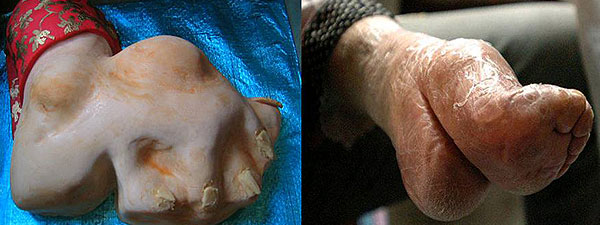
I have known about the practice of Chinese foot binding for years without ever fully understanding it. I have recently read Jung Chang's book Wild Swans which was a fascinating read and highly recommended, Jung in this book describes her grandmothers bound feet in detail. After I read her description I still did not fully grasp the way the foot was shaped, and embarked on further research.
Brief history
It is believed that foot binding originated in the Tang Dynasty (618–907), and seems to have been an almost purely Han tradition as the Manchu and other minorities did not practice foot binding.
There are three stories of origin for foot binding, all credited to the court of Emporer Tang Daizong (Li Yu):
- The Emperors' favorite concubine had unusually small feet, and that the upper classes began to bind their feet to emulate her.
- The Empress had club feet and she convinced the emperor to order that all women were to bind their feet so that she would be setting her deformity as a model of beauty and elegance.
- It is reported that in the 8th century Yao-Niang the consort of Emperor Li Yu of the Tang Dynasty
performed a dance on a ‘golden lotus’ pedestal, wrapping her feet in
silken cloths.This apparently became the fashion, and evolved with time.

Foot binding usually started when a girl was between 3 and 5 although some were bound much later in some cases such as poor families which caused much more pain.
Firstly the feet were soaked in a warm bowl of herbs and animal blood, and the nails clipped back. Four toes were broken then bent back under the foot. The arch of the foot was bent upwards and the arch broken by force to shorten the foot, this was easier when the girl was young when the bones were soft. Sometimes the sole of the foot was cut with a knife to attain the "proper" shape, while the big toe remained untouched. The feet were then bound tightly in bandages soaked in the water, herb and blood solution, and as the bandages dried they tightened even more.

The feet had to be cared for on a daily basis by soaking them and trimming the nails. If the nails were not trimmed they would grow into the soles of the feet, and cause an infection. This was a daily affliction, and was done for the rest of the women's lives. As well as the excruciating pain of the binding itself, the feet were
commonly prone to other complications – from swelling and pus-filled
sores in the early stages of the treatment, to paralysis and serious
infections such as gangrene.
Bound feet were covered with tiny shoes, which were perfumed, ornately beaded and embroidered.
The men are said to have had a fettish for the bound feet which they named "lilly feet". The "ideal" foot was 3 inches and were named "Golden Lotuses". Feet that were between 3-4 inches were called "Silver Lotuses".
Men who were turned on by bound feet were called "lotus lovers", and are reported to have eaten watermelon seeds and almonds off the feet. It is also said that some men used to drink the water that these feet were soaked in. During the Qing Dynasty, love manuals apparently detailed 48 different ways of fondling a woman’s bound feet.
It was believed that women that had their feet bound would walk a certain
way that strengthened and tightened the vagina, and that the woman's
buttocks and "jade gate" would develop in such a way that the woman's
"Jade Gate" would grip the man's "jade spear" tightly.
During the Song Dynasty's (960-1279) foot binding was used to control women, and deprive them of any independence.

Manchus never adopted the practice, and with the formation of the Manchu state known as the Qing dynasty (1644-1911) they tried to put an end to the practice, but failed.
Foot binding could be seen in the United States in the late 19th century as can be seen in the photo on the right taken in San Fransisco.
It is believed that 1 billion Chinese women had their feet bound
since the
practice started.
The first anti foot binding society was formed in 1895 in Shanghai,
eventually spreading across the country. All registered members were
not allowed to marry any woman with bound feet. Finally, foot binding
was officially banned in 1911 during the Revolution of Sun Yat Sen.
In the the 1980s photographer Joseph Rupp photographed some women with bound feet in the
Bound feet project and asked these women to tell their stories.
Lu Zhen-lan told him "Washing and rebinding is not something others should see. I am happy to
tell you about myself and foot binding, but you may not write about me or
take a picture if you plan to publish them in a pornographic magazine".
Most of the remaining women with bound feet have relatively moderate
deformities compared to those of a century earlier, as the practice of
foot binding became more clandestine after the 1911 ban. That meant many
of these women were older when the binding started. Also, those who
unbound their feet under communist rule often saw the length of their
feet grow over time. Within a decade or two, the last living examples of
foot binding will be gone, and all that will remain are the tiny lotus
shoes.
In 1998 the Chinese Xinhua news agency announced that the last factory to manufacture shoes for bound feet in Harbin had ended production.
Zhou Guizhen (86) in 2007 shows her bound feet, followed by additional photos of bound feet